
Author: Stefano Piacentini
Light dark matter candidates: a general overview
The Axion-like particles
Sterile neutrinos
According to the Standard Model of particle physics, there are three species of neutrinos – 𝜈e, 𝜈𝞵, and 𝜈𝞽 – which can interact with electrons, muons, and tauons via weak interactions. Since they have a very small mass, not greater than O(0.2 eV/c2), they could only contribute to a small fraction of the total amount of DM in our universe. However, there are theories that enlarge the set of neutrinos by adding a new neutrino particle that has no weak, strong or electromagnetic interactions with the other particles of the Standard Model: the so-called “sterile” neutrino 𝜈s. The only interaction between the sterile neutrinos and the other particles of the standard model can happen only via oscillations to standard model neutrinos. In the case in which the mass of this particle is of the order 1 keV/c2 or above, the sterile neutrino is a viable DM candidate, as it’s neutral, heavy enough, interacting very weakly, and stable over a cosmological timescale. Some of their decays can produce monochromatic O(keV) X-ray emissions, and today there are hints of observations of such peaks in the X-ray spectrum of galaxies or galaxy clusters with an expected high DM density.
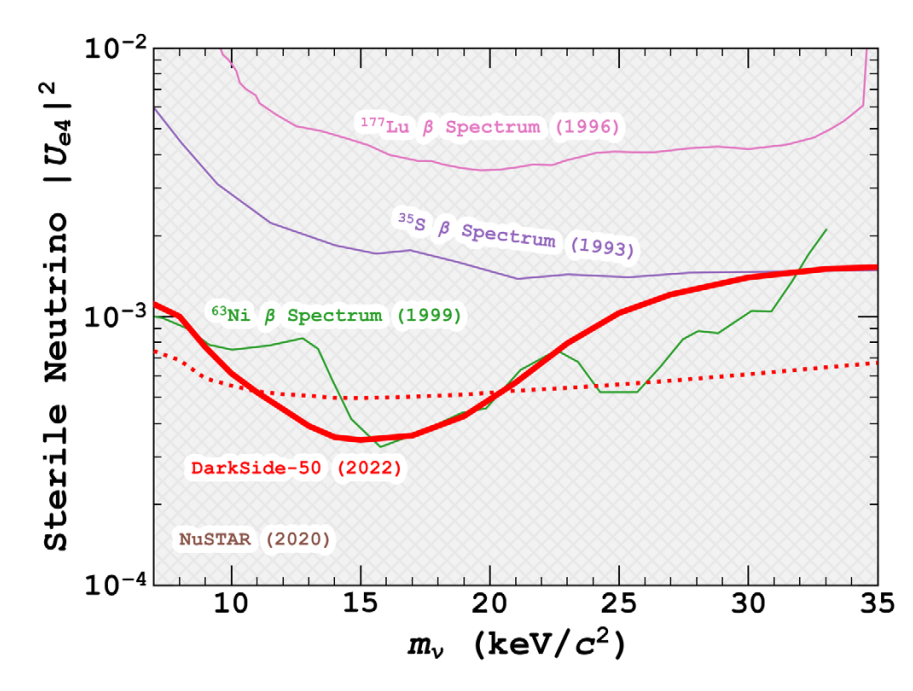
In DarkSide detectors, the sterile neutrinos could be detected via the process 𝜈s + e → 𝜈e + e (and its antineutrinos counterpart), parameterised by the mixing angle |Ue4|2 between this fourth-family lepton and the electronic one. This absorption process by argon shell electrons would result in a monoenergetic signal at the particle’s rest mass. Figure 2 reports the results of the search for such DM candidates using the DarkSide-50 data.
Dark photons
The dark photon is a hypothetical vector-boson particle which has the role of force carrier for the so-called “hidden sector”, a new set of particles that are not directly interacting with the Standard Model particles. The dark photon, which acts as a regular Standard Model photon in the hidden sector, can interact with the Standard Model one via a mechanism known as kinetic mixing. The coupling between the regular photon and the dark photon is therefore the only mechanism through which the hidden sector is connected to the Standard Model.
The dark photons and the particles in the hidden sector are naturally viable dark matter candidates: massive, neutral, very weakly coupled to the Standard Model particles, and stable over a cosmological timescale. Like ALPs, in the DarkSide detectors they could be detected via their absorption by argon electrons. Also in this case, the absorption would result in a monoenergetic signal at the particle’s rest mass. Figure 3 shows the constraints on the dark photon kinetic mixing parameter 𝜅 obtained analysing the DarkSide-50 dataset.

References
[1] Phys. Rev. Lett. 130 (2023)
[2] Phys. Rev. D 107 (2023)