
Author: Luciano Pandola
The ReD experiment
The Recoil Directionality (ReD) project operates since 2018 a miniaturized dual phase Argon TPC, readout by Silicon Photomultipliers (SiPM). The main goal of the project is to study the response of the detector to nuclear recoils, as expected from WIMP interactions. Two different scientific cases have been addressed:
- scrutinize the directionality effect, i.e. the potential sensitivity of the Argon TPC to the direction of the nuclear recoil, as suggested by the result of the previous SCENE experiment;
- measure the response of the detector to very low-energy nuclear recoils (< few keV), that would be produced by low-mass WIMPs.
In addition, as the ReD TPC features the same SiPM readout foreseen for DarkSide-20k, it was a very valuable test bench, allowing to test the detector performance within a realistic scenario.
The ReD TPC
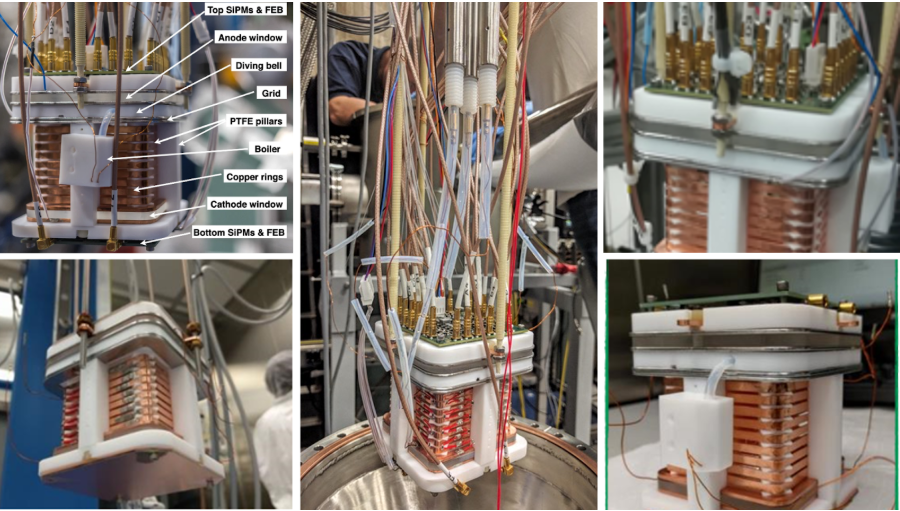
The heart of ReD is the dual-phase Argon Time Projection Chamber (TPC). It is a fist-sized detector (5 x 5 x 6 cm), basically a miniaturized version of the DarkSide-20k TPC. The TPC is delimited on the top and on the bottom by two transparent windows made of acrylic, and on the sides by acrylic walls. The top and bottom windows are coated with a thin layer of a transparent conductor (called ITO) so they can be operated as electrodes to establish an electric field in the TPC.
As in all dual-phase TPCs, the liquid is topped by a thin gaseous layer (the “gas pocket”). Upon an interaction inside the liquid volume, a prompt light signal, called scintillation or S1, is produced. Then, electrons generated in the liquid are drifted towards the gas-liquid interface by the electric field, extracted in liquid and then accelerated to produce the delayed electroluminescence signal S2. The time delay between S1 and S2 is proportional to the distance between the initial interaction point and the liquid-gas boundary.
The light signals S1 and S2 are detected by two arrays (“tiles”) of SiPMs, which are located behind the transparent windows. Each array is made of 24 SiPMs, each of about 1 cm2 area. The 24 SiPMs of top tile are readout individually: this is because the pattern on the S2 signal detected by the individual SiPMs can be used to estimate the position of the initial interaction point. The light detectors of the bottom tile are readout in groups of six instead.
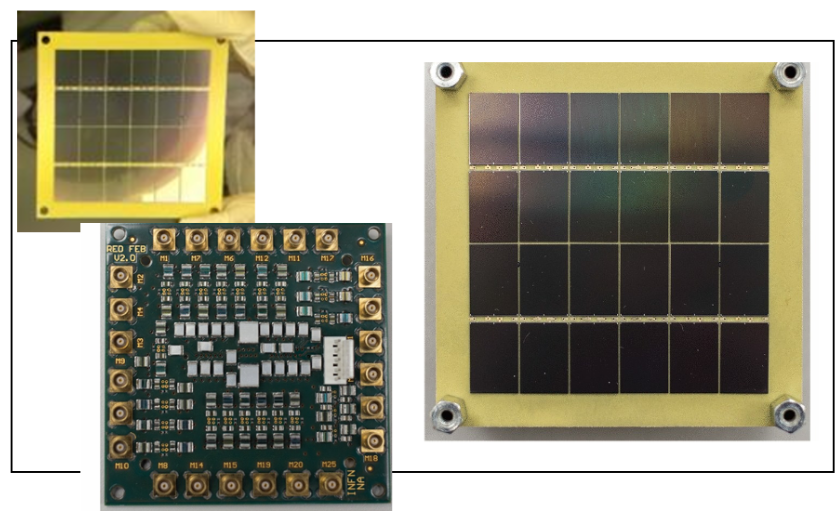
Before starting the experimental program, the ReD TPC was studied and characterized in depth at INFN Napoli [1], in order to ensure that the performance met the requirements necessary to achieve the scientific goals of the subsequent phases.
Directionality studies
Directional sensitivity is a key asset for any WIMP-searching experiment: in fact, since Earth, with the entire Solar System, is traveling towards a specific direction within the Milky Way, it is expected that Earth is facing an apparent “galactic wind” of WIMPs, coming from the opposite direction, i.e., from the Cygnus constellation. The correlation between the nuclear recoil direction and the expected direction of the WIMP galactic wind would, therefore, represent an unmistakable smoking gun for a possible dark matter discovery.
The SCENE experiment [2] provided a hint that a dual-phase Ar TPC may have directional sensitivity for nuclear recoils, i.e., that the response of the TPC is different for nuclear recoils having the same energy but in a different direction. Given the critical importance of this capability, the ReD experiment was designed to scrutinize this possible sensitivity. For this purpose, it is necessary to produce Ar recoils in the TPC of known energy and direction: this is achieved by irradiating the detector with neutrons, which interact with Argon nuclei and produce nuclear recoils, as much as WIMPs.
Neutrons of suitable energy were generated by shooting a 7Li beam from the TANDEM accelerator of the INFN Laboratori Nazionali del Sud (Catania, Italy) onto a CH2 target. The reaction of 7Li on the hydrogen within the target produces a neutron and an accompanying 7Be nucleus, which can be detected and used for tagging. Neutrons scattered by 40Ar nuclei in the TPC are then detected by a neutron spectrometer made by an array of liquid scintillators.
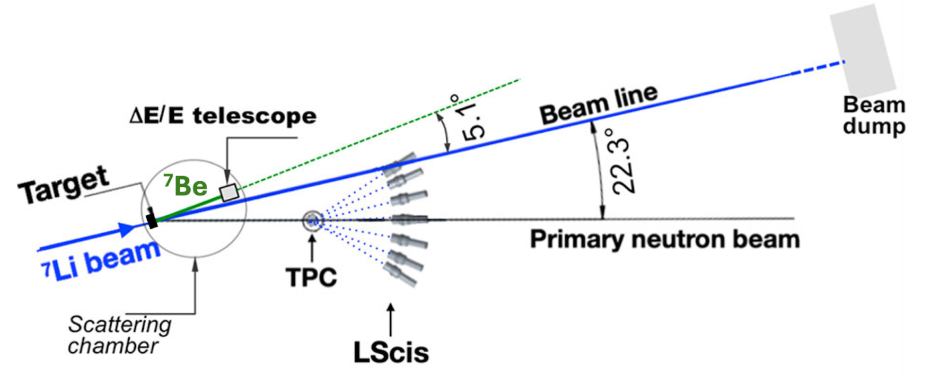
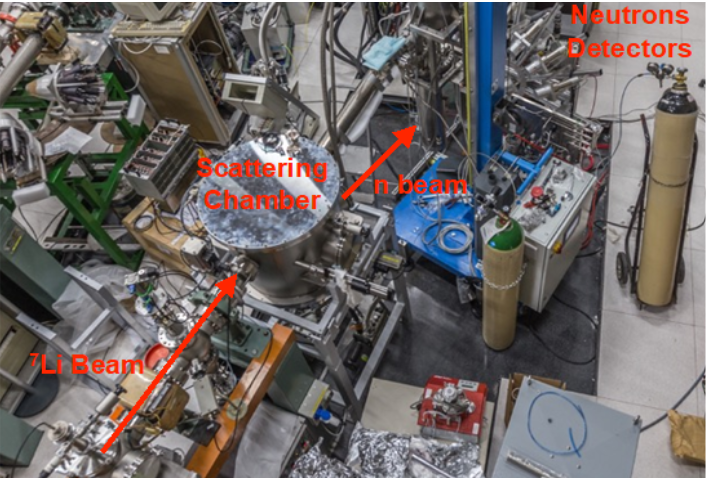
Due to the two-body kinematics, the detection of the scattered neutron at a given angle is sufficient to infer the energy and direction of the nuclear recoil in the TPC.
The beam run took place in February 2020: the configuration was set up to tag nuclear recoils of about 70 keV in the TPC, emitted in different directions with respect to the electric field, in order to test a potential directional sensitivity. Data were analyzed according to a dedicated theoretical model [3]: no evidence of directional sensitivity was found and an upper limit on the extent of the effect could be set [4].
Measurement of the TPC response at low- energy
Understanding the response of an Ar dual-phase TPC to very low- energy nuclear recoils is crucial for experiments searching for low-mass WIMPs. In this case, the recoil energy of the Ar nucleus is very low (< a few keV), and the S1 signal is often undetectable, thus leaving the ionization S2 signal only. Measurements of the ionization yield in Argon are very poor at low energy: direct measurements are only available up to 7 keV.
A dedicated measurement employing the ReD TPC was designed in order to cover the gap and extend the coverage down to 2 keV. As before, the key idea is to produce Ar recoils in the TPC of known energy by irradiating the detector with neutrons. For this measurement, neutrons are produced from a 252Cf source by fission events, together with nuclear fragments and gamma rays: the latter can be detected by a nearby detector to provide an event-start signal. Neutrons are collimated by a polyethylene structure within a cone of about 2° opening, which points towards the TPC. As above, neutrons that are scattered by Ar nuclei in the TPC are then detected by a neutron spectrometer, which is made by two arrays of plastic scintillators. The plastic scintillators used in this measurement are smaller than the liquid scintillators used for the directionality runs in order to improve the angular resolution. The time of flight of neutrons from the 252Cf source to the neutron spectrometer is used to measure its kinetic energy: the timing resolution is as good as 0.7 ns, which allows the neutron energy to be measured at better than 5%.
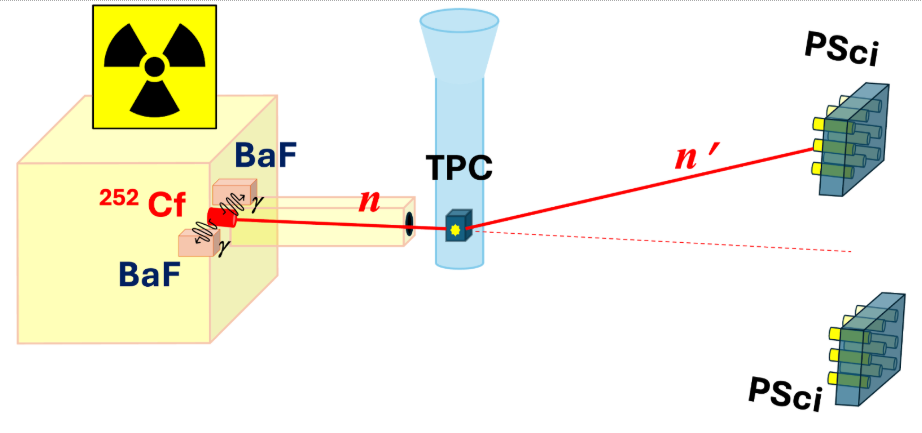
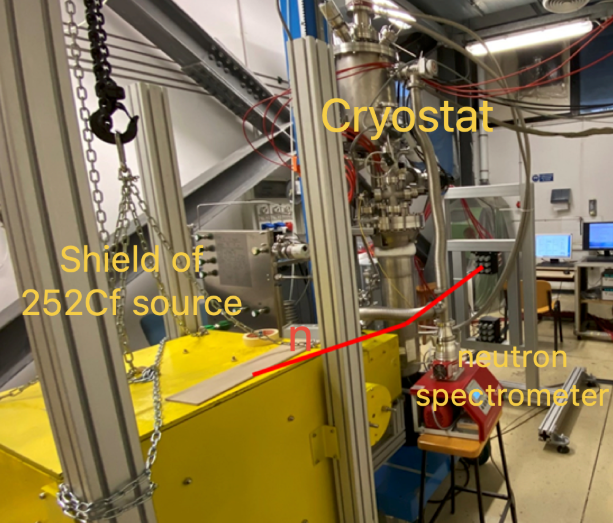
The data taking took place between January and March 2023 at the INFN Sezione di Catania. Data analysis has confirmed that ReD collected and characterized a sample of nuclear recoils down to 2 keV, thus meeting its design goal [5].
What’s next?
The ReD effort will be further extended by a new project, ReD+, funded by a PRIN grant from the Italian Ministry of Research. ReD+ is designed to push the sensitivity down to 0.5 keV, by using the same conceptual design of ReD and improved experimental set-up.
One of the key elements of this next phase is the DD-Neutron Generator, which is being commissioned at the University of São Paulo Physics Institute. This device generates neutrons from a deuterium-deuterium reaction. The main motivation for its usage is the well-collimated mono-energetic neutron beam, which allows the exploration of lower recoil energies and a better look for possible directional sensitivity.
References
[1] P. Agnes et al., Eur. Phys. J. C 81, 1014 (2021)
[2] H. Cao et al., Phys. Rev. D 91, 092007 (2015)
[3] P. Agnes et al., Eur.Phys. J. C 84, 24 (2024)
[4] V. Cataudella et al., JINST 12, P12002 (2017)
[5] I. Ahmad et al., PoS TAUP2023 (2024) 052