
Author: Stefano Piacentini
DarkSide-50: a general overview
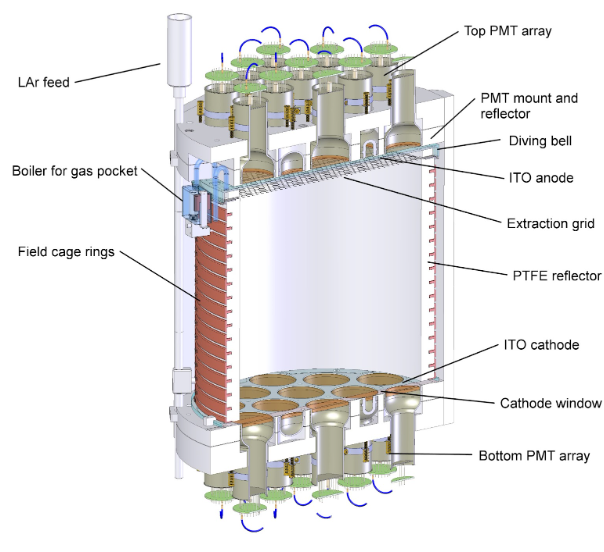
DarkSide-50 is an experimental project aiming at the direct detection of dark matter (DM) interactions. The detector features a dual phase underground argon Time Projection Chamber (TPC) which successfully operated underground at Laboratori Nazionali del Gran Sasso (LNGS) from 2013 until 2019. The active argon mass contained in the TPC is (46.4 ± 0.7) kg: the interactions happening inside this volume result in the production of light (see next sections for more details), and this light is detected by means of two sets of 3” photomultiplier tubes (PMTs), 19 at top and 19 at the bottom of the chamber. This structure, depicted in Fig.1, is placed inside the Liquid Scintillator Veto (LSV), a 4 m diameter stainless steel sphere containing an organic scintillating liquid loaded with boron that acts as a neutron veto. The LSV is in turn located within the Water Cherenkov Veto (WCV), a steel cylinder with a height of 10 m and a diameter of 11 m which, filled with ultrapure water, acts as a Cherenkov detector to veto the cosmic rays. DarkSide-50 was able to set the most stringent bound to the cross section of spin-independent dark matter-nucleon interactions for DM particles with masses in the [1.2, 3.6] GeV/c2, being able to exclude cross section of 6×10-43 cm2 for a 3 GeV/c2 mass DM-nucleon interaction. Moreover, it was possible to constrain the parameter space for several other physics cases (dark matter-electron interactions, axion like particles, sterile neutrinos) of relevant interest for the scientific community.
Given the success of DarkSide-50, to explore lower and lower DM-nucleon spin-independent cross sections, the DarkSide collaboration is now commissioning a bigger and upgraded version of the detector called DarkSide-20k, foreseen to be operative at LNGS in 2028.
Why is the detector underground, below the Gran Sasso massif?
DarkSide-50 was deployed underground at LNGS, 1400 m below surface, inside the Gran Sasso massif. In fact, due to the extremely low expected event rate of dark matter – less than 1 event per kilogram per year – the DM detection is highly challenging. Additionally, the absence of distinctive features, such as knees or peaks, in the expected energy spectrum of the DM-nucleon interaction makes it even more difficult to identify a possible positive signal, further emphasising the need to minimise background events. It is therefore a natural choice to deploy these experiments underground, where the cosmic ray background is reduced by several orders of magnitude, and to foresee a shielding system to reduce even further the number of events that are caused by external sources.
Working principle of the DarkSide dual phase LAr TPCs
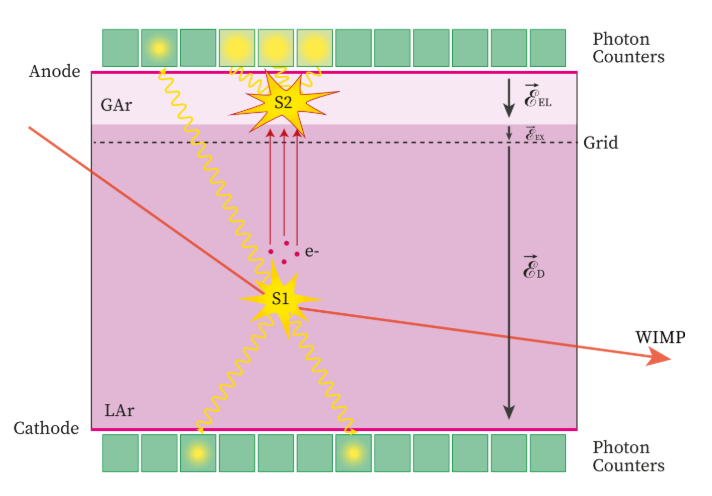
DarkSide experiments use the technology of two-phase LAr TPC to detect particle interactions within a liquid argon active volume, collecting both scintillation light and ionisation electrons produced upon the interaction. These give rise to two distinguishable signals referred to as S1 and S2, respectively. The charge collection chain leading to the formation of the S2 signal is the most delicate aspect of a two-phase LAr TPCs. By using a suited electrostatic field (drift field), electrons are swept from the interaction locus towards a region containing gaseous argon (the “gas pocket”), then they are extracted from the liquid (via the extraction field) and finally undergo a process of charge-to-light conversion with an extremely advantageous conversion factor, resulting in an efficiency close to 100%.
The charge-to-light conversion is obtained via a much stronger electric field compared to the drift field, enabling electrons to undergo electroluminescence (EL) ,i.e., the production of scintillation light followed by atomic excitations caused by collisions from fast moving electrons. Both the initial scintillation in the liquid phase and by the EL in the gas phase are detected by photodetectors placed above the gas layer. In order not to impede light collection, the anode and cathode for field generation must be transparent and an additional electrode, usually in the form of a grid or a mesh to allow the passage of electrons, is placed below the liquid-gas interface to decouple the drift field from the extraction and EL fields. A scheme of the working of a two-phase LAr TPC is shown in Fig. 2.
In the case of the DarkSide-50 detector, the TPC is a cylinder of 36.5 cm height and diameter. The TPC walls are made of a 2.54 thick Teflon reflector (PTFE), while the top and bottom caps are made of two fused silica windows. The gas pocket is 1 cm thick and the extraction grid is located 0.5 cm below the liquid-gas interface. All the surfaces in contact with the active volume are coated with a thin layer of TetraPhenyl Butadiene (TPB), a wavelength shifter material capable of absorbing the 128 nm light produced by the argon and emit 420 nm photons, which can be efficiently detected by the PMT arrays. The anode and the cathode were made of 15 nm thick transparent conductive Indium Tin Oxide (ITO) films, deposited in the two internal phases of the silica windows that separate the active volume and the PMTs. The electric drift field inside the TPC is realised by means of copper rings placed outside the cylindrical TPC wall – see Fig.1 – and set at graded potentials. The standard data taking conditions for DarkSide-50 were a drift field of 200 V/cm, an extraction electric field equal to 2.8 kV / cm and a drift field in the gas pocket equal to 4.2 kV/cm.
The S2 signal shape and intensity are strongly dependent on the thickness and density of the gas pocket and on the intensity of the amplification field. In a standard two-phase TPC, it is extremely hard to fully validate models for the mechanisms behind S2 production, as geometrical factors are fixed by design. This has pushed the Collaboration into pursuing the DarkSide Proto project as a guide for the finalisation of the gas pocket design in DarkSide-20k to achieve the best detector’s performance in the analysis region of interest for dark matter detection.
The results of DarkSide-50
