Author: Stefano Piacentini

Light dark matter candidates: a general overview

Traditionally, experiments located in underground laboratories have focused on searching for dark matter (DM) particles with masses ranging from a GeV/c2 to a few TeV/c2 by looking for their interactions with ordinary matter via elastic scattering off atomic nuclei. These interactions are usually called nuclear recoils (NR). In principle those “heavy” DM particles can also undergo scattering off atomic electrons, the so-called electron recoils (ER), but the cross section of such interactions is kinematically disfavoured given the large difference in mass between the two particles – DM and the electron. The possible existence of DM particles in this mass region is strongly supported by theoretical motivations – see the WIMP section. However, the lack of uncontroversial evidence of direct detection of heavy DM particles motivates the search for particle candidates outside the traditional mass range. In this regard, the sub-GeV/c2 mass region is well theoretically motivated and there are a plethora of theories providing viable DM candidates. Being predicted in a mass range which is much smaller than the mass of the nucleons, those light particles are usually searched for by looking at their scattering off, or absorption by, atomic electrons. In the following sections we will shortly describe light DM candidates that have been tested so far with DarkSide detectors. 

The Axion-like particles

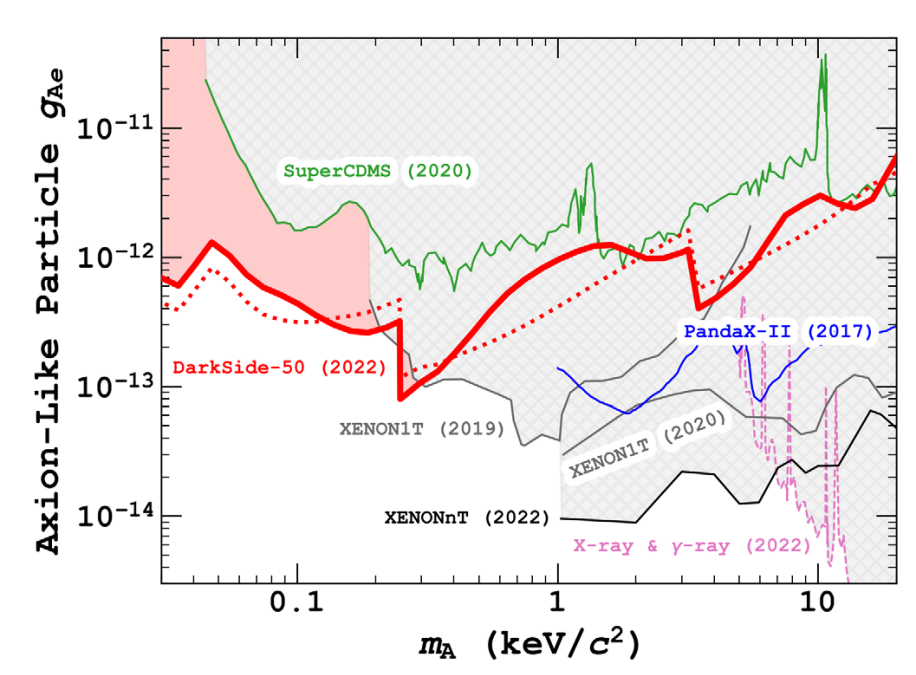
Axions have been theorised by R. D. Peccei and H. R. Quinn as an ingenious solution to the so-called strong CP problem of the QCD (Quantum ChromoDynamics), namely the lack of predicted CP violation in strong interactions. The solution proposed by Peccei and Quinn is to add an additional spontaneously broken chiral symmetry to the Standard Model of particle physics. With this assumption, the presence of a new neutral massive bosonic pseudo-scalar particle, called “QCD axion”, is predicted. More in general, we usually refer to any pseudo-scalar bosonic particle that arises from the spontaneous breaking of a global symmetry as “axion-like particles” (ALPs), even if not necessarily addressing the strong CP problem. ALPs and axions are promising DM candidates and, with masses spanning several orders of magnitude in the sub-GeV/c2 mass region, they can satisfy the stability requirements needed to explain the abundance of DM that we evaluate from observations today in the universe. Based on the most relevant theories, they are coupled to electrons and photons and can be produced by astrophysical sources, like our Sun, being therefore in principle detectable on Earth. In our detectors, the ALPs can interact with electrons via two mechanisms: the axio-electric effect, analogous to the photoelectric effect but with axions replacing photons, and the “inverse Primakoff” effect, where the ALPs are converted into regular photons during the interaction with the electrons. Figure 1 shows the constraints set by DarkSide-50 on the axio-electric coupling constant gAe.
Sensitivity of DarkSide-50 to axions
Figure 1. Exclusion limits at 90% C.L. set by DarkSide-50 on axio-electric coupling constant, compared to results from other experiments (SuperCDMS, XENON1T, XENONnT, PandaX-II). Figure from Phys. Rev. Lett. 130, 101002

Sterile neutrinos

According to the Standard Model of particle physics, there are three species of neutrinos – 𝜈e, 𝜈𝞵, and 𝜈𝞽 – which can interact with electrons, muons, and tauons via weak interactions. Since they have a very small mass, not greater than O(0.2 eV/c2), they could only contribute to a small fraction of the total amount of DM in our universe. However, there are theories that enlarge the set of neutrinos by adding a new neutrino particle that has no weak, strong or electromagnetic interactions with the other particles of the Standard Model: the so-called “sterile” neutrino 𝜈s. The only interaction between the sterile neutrinos and the other particles of the standard model can happen only via oscillations to standard model neutrinos. In the case in which the mass of this particle is of the order 1 keV/c2 or above, the sterile neutrino is a viable DM candidate, as it’s neutral, heavy enough, interacting very weakly, and stable over a cosmological timescale. Some of their decays can produce monochromatic O(keV) X-ray emissions, and today there are hints of observations of such peaks in the X-ray spectrum of galaxies or galaxy clusters with an expected high DM density.


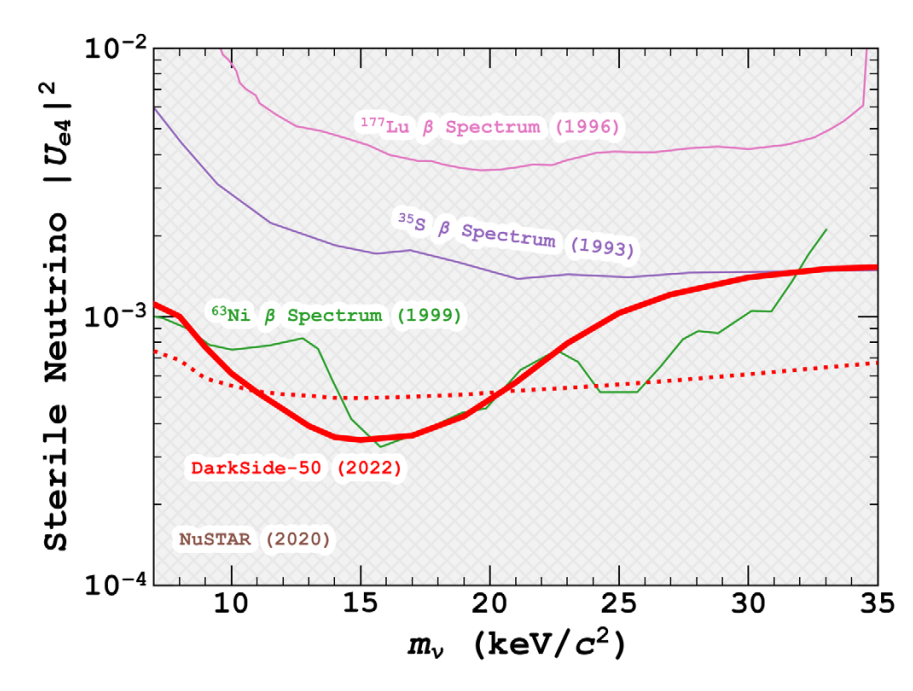
In DarkSide detectors, the sterile neutrinos could be detected via the process  𝜈s + e →  𝜈e + e (and its antineutrinos counterpart), parameterised by the mixing angle |Ue4|2 between this fourth-family lepton and the electronic one. This absorption process by argon shell electrons would result in a monoenergetic signal at the particle’s rest mass. Figure 2 reports the results of the search for such DM candidates using the DarkSide-50 data.
Exclusion limits of DarkSide-50 to sterile neutrinos
Figure 2. Exclusion limits at 90% C.L. set by DarkSide-50 on mixing angle |Ue4|2 for sterile neutrinos. Figure from Phys. Rev. Lett. 130, 101002

Dark photons

The dark photon is a hypothetical vector-boson particle which has the role of force carrier for the so-called “hidden sector”, a new set of particles that are not directly interacting with the Standard Model particles. The dark photon, which acts as a regular Standard Model photon in the hidden sector, can interact with the Standard Model one via a mechanism known as kinetic mixing. The coupling between the regular photon and the dark photon is therefore the only mechanism through which the hidden sector is connected to the Standard Model.


The dark photons and the particles in the hidden sector are naturally viable dark matter candidates: massive, neutral, very weakly coupled to the Standard Model particles, and stable over a cosmological timescale. Like ALPs, in the DarkSide detectors they could be detected via their absorption by argon electrons. Also in this case, the absorption would result in a monoenergetic signal at the particle’s rest mass. Figure 3 shows the constraints on the dark photon kinetic mixing parameter 𝜅 obtained analysing the DarkSide-50 dataset.

Exclusion limit of DarkSide-50 to dark photons

References

[1] Phys. Rev. Lett. 130 (2023)

[2] Phys. Rev. D 107 (2023)