
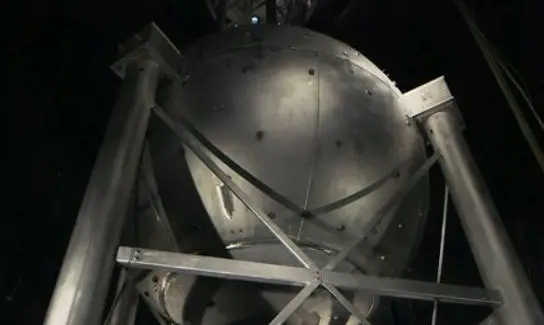
The argon target
There is a wide range of astronomical evidence that the visible stars
and gas in all galaxies — including our own — are immersed in a much
larger cloud of non-luminous matter, typically containing much greater
(by orders of magnitude) amounts of mass.
The existence of this
“dark matter” is consistent with evidence from large-scale galaxy
surveys and cosmic microwave background measurements, which indicate
that the majority of matter in the universe is non-baryonic. The nature
of this non-baryonic component is still totally unknown, and the
resolution of the “dark matter puzzle” is of fundamental importance to
cosmology, astrophysics, and elementary particle physics.
One
leading explanation, motivated by supersymmetry theory, is that dark
matter is comprised of as-yet-undiscovered Weakly Interacting Massive
Particles (WIMPs) formed in the early universe and subsequently
gravitationally clustered in association with baryonic matter.
In
principle, WIMPs could be detected in terrestrial experiments through
their collisions with ordinary nuclei, giving observable low-energy
(<100 keV) nuclear recoils. The predicted collision rates are
extremely small and require ultra-low background detectors with large
(1–100 ton) target masses, located in deep underground sites to
eliminate neutron background coming from cosmic ray muons.